Introducing EduSignal: Adventures in Vibe Coding Pt. 2
Sharing a new project: EduSignal - The K-12 District Intelligence Platform
Two months ago I wrote a post titled “Adventures in Vibe Coding” which documented my first attempt at using AI-assisted software development to attempt to create something useful. That project was an AI prompt library for marketers - a very simple concept built entirely using Lovable, one of the most popular no-code vibe-coding platforms.
The most important part of that project was the learning process, which inspired me to try a more robuts and technically sophisticated approach using Claude Code, which exploded onto the vide-coding scene in recent months. This resulted in the Disruption-Fluency Self-Assessment, a fully-functional standalone online assessment tool with an extensive back-end scoring logic, integrated personalized PDF generation, email capability, admin/reporting, and more, all built from ground-up in Claude without using any existing survey tools or platforms.
The confidence I gained from that inspired me to aim bigger: Could I build, as a soloprenuer with limited but non-zero development skills, a fully-functional, production-ready, app that solved a real-world customer problem and successfully bring it to market? Turns out, the answer is “yes I can” thanks to the power of Claude Code and a host of complementary platforms and tools.
Introducing EduSignal - The K-12 District Intelligence Platform
With that, I’d like to introduce EduSignal - The K-12 District Intelligence Platform for EdTech Sales. EduSignal was envisioned to solve a very targeted pain point for sales reps operating in the US K-12 education marketplace, one I encountered in my previous roles as CMO's for education vendors:
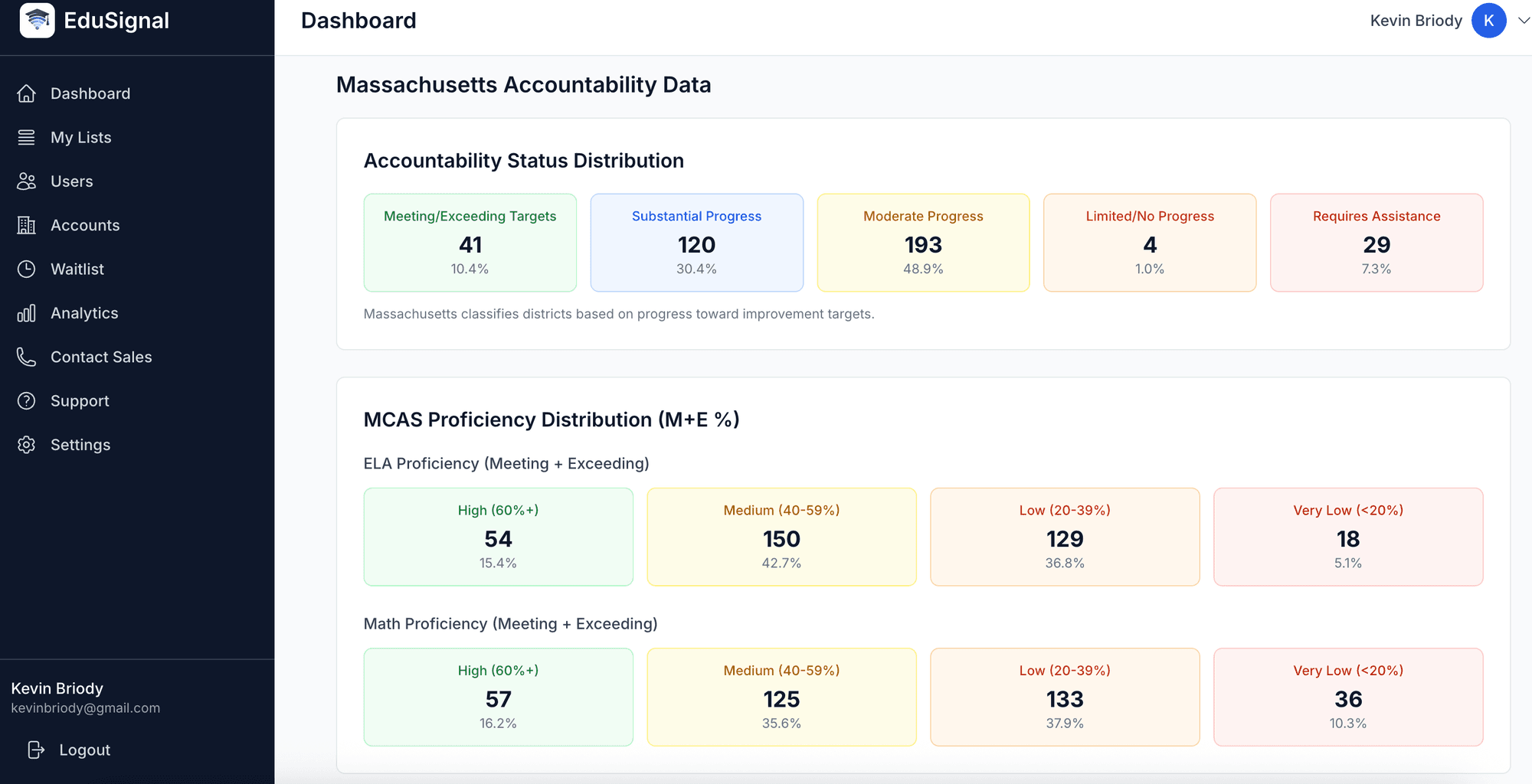
Every day, sales reps waste hours researching school districts, bouncing between NCES, state DOE websites, district pages, and news articles, just to understand who they're talking to before a call. EduSignal consolidates public K-12 data into instant district profiles: enrollment trends, demographics, test scores, state performance grades, and more. One search, one profile, everything you need to start the conversation.
EduSignal not a data broker or an RFP tracker; the K-12 market is awash in those, including GovSpend and RFPSchoolWatch. Rather it's a pre-sales intelligence tool for reps before they make their next call or visit with a district prospect. EduSignal has baked in AI (using Claude 4.5 Haiku, a great mix of context, accuracy, and per-token costs) to generate instant sales analysis using the combined context of a given district's, or even a portfolio of districts, data and your K-12 product or solution information.
K-12 public datasets are an absolute mess when you start exploring them across state lines. The current state of the US Department of Education and in particular National Center for Education Statistics (NCES) doesn't inspire much confidence that national standardization will become the norm. EduSignal tries to make them simple and easy to reference.
Take a look at the click-through demo below to see it in action. The current live app includes over 11,000 K12 public school district profiles across 26 states, with more being added each day as EduSignal progresses to true national coverage.
How did I create EduSignal?
Based on my experience building the DFM Assessment, I learned about both the power and limitations of Claude Code, plus how to set up a "proper" app development environment and infrastructure that would suit an application like this - GitHub, hosting, databases, front/back-end tools, and all the various add-ons like a headless CMS for content, email components, authentication, billing, and so on.
Where I - and frankly Claude Code - had to learn on the fly was how each US state's department of education structured their K-12 data, what was available and in what format, and how to normalize and integrate that all into a long-term scalable data model and app platform without ending up in a chaotic mess. It turns out the code for the app was actually the easy part; K-12 state data can be generously described as "varied" and unfortunately federal data NCES only partially fills in that gap. Each state is a little adventure in data exploration, which fortunately is a place where AI comes in extremely handy.
What did I learn in the process?
- Claude Code (4.5 Opus) is an almost magical tool; with it I feel like I could build almost anything short of a high-end SaaS app. It, and it's successors, will permanently alter the landscape of what's possible, for everyone from solo-entreprenuers to enterprise IT teams to functional marketing teams looking to "roll their own" point solutions that they would otherwise have to outsource to a vendor. What does this mean for the myriad small SaaS apps with minimal defensible moats? We don't yet know, but it certainly means changes in the landscape for marketing and other enterprise tech stacks is coming incredibly fast.
- But it's not infallible magic. Claude Code, and other AI vibe-coding tools and engines, needs structure, guidance, and some reasonable understanding of how apps and sites are built and run on the part of the user. Even with the best and frequently updated PRD's and reference documentation (which is crucial) and following all the correct best practices, Claude Code still misses or "forgets" steps; it can get confused and recommend the wrong thing; it can break working code without realizing it; it routinely runs out of context and needs to be reminded of the lay of tha land. It's a powerful ally, but it needs clear and careful guidance. It's not quite your "AI technical cofounder" at this stage.
- The gap between "functional MVP or internal app" and "viable production product ready for others to buy and use" is enormous. Security, authentication, pricing/payments, T&Cs, privacy considerations, and of course, branding, content and marketing, all take as much or more time than actually building the platform. But the central idea, that even non-technical teams can vibe-code up functional niche solutions for limited use, or solopreneurs like me can get from zero to functional proof of concept in no time, is an incredibly powerful concept with mind-blowing implications.
So what's next for EduSignal?
The app exists as a usable and I believe genuinely useful solution particularly for sales teams in small-to-midsized EdTech vendors who don't have access to state research teams or deep CRM data enrichment. Or even for reps and SDR's in large companies who want a quick, easy-to-use reference tool to ensure they are well-prepared before their next customer call and visit.
The aggregation and visualization of the data alone is powerful; toss in the contextualized AI sales analysis, ability to create unlimited target lists of districts (and do AI opportunity analysis across all of them), all in a clean, mobile-ready platform, and EduSignal is something I plan on evolving for some time to come.
If you know of anyone in education sales that would like to give it a try, please encourage them to check it out (free trial!) - or have them message me to learn more, and I'm happy to speak with anyone or demo the platform anytime.
Or hey, watch a quick video:
EduSignal Launch Introduction Video
But this the stage of the project where the fun begins, at least for a marketer like me. Now I get to roll out the EduSignal content marketing and paid media strategies, including resources like a Sales Playbook, and see where this goes. It may amount to nothing, or become something genuinely viable, but either way it's part of a fairly incredible learning journey that I encourage everyone interested in creating or solving problems with this powerful new class of tools and technologies to embark on. Just learning how to build like this, on my own, has been one of the most eye-opening and empowering experiences of my career so far.
Happy vibe-coding!