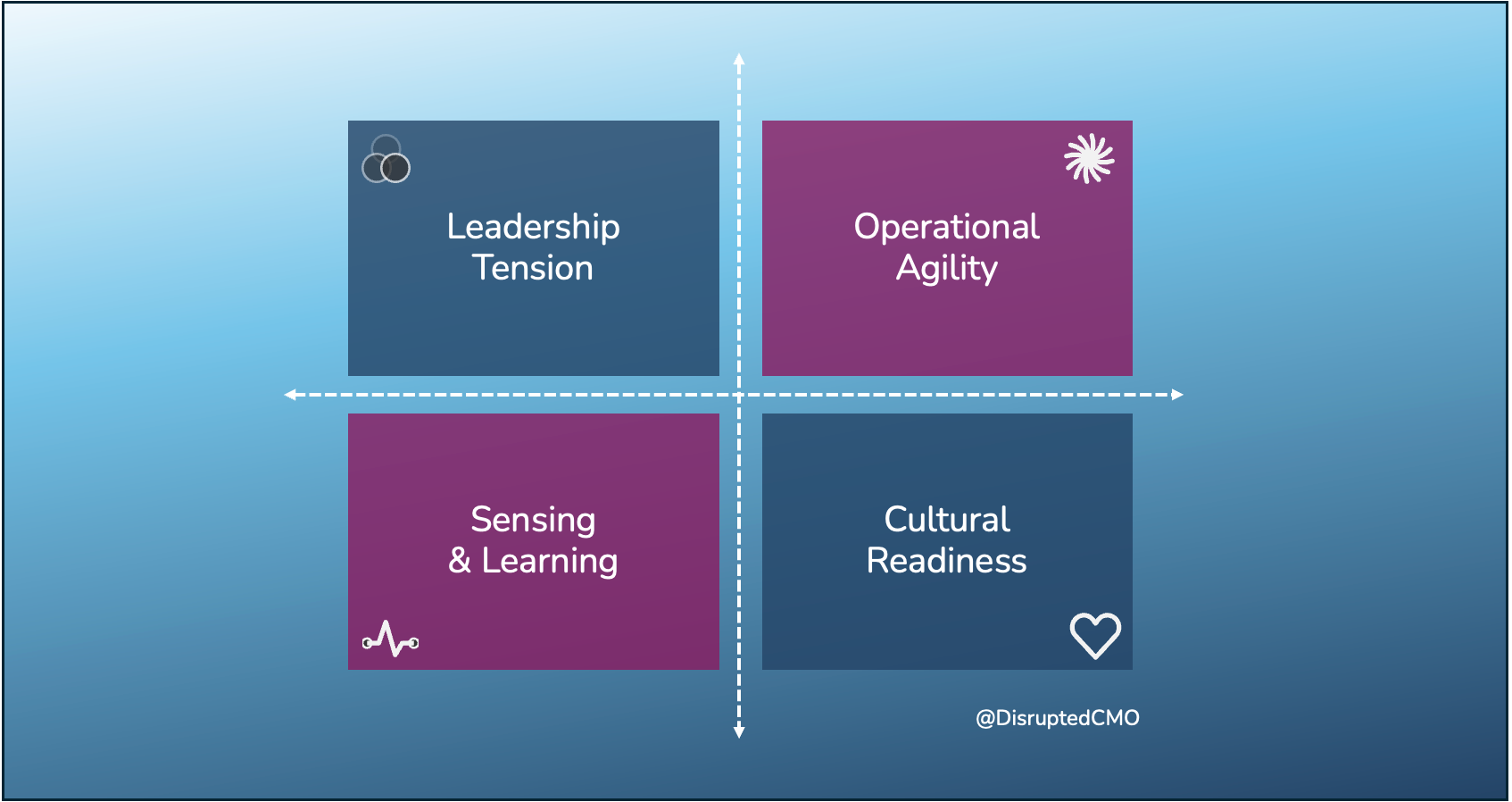
The Four Dimensions of Disruption Fluency
Introducing the Four Dimensions of Disruption Fluency: The practical framework that sits at the core, providing the rubric for leaders to assess where they stand and, most critically, a guide to where to focus their efforts in order to develop true disruption fluency.
How do you know if your marketing organization is actually equipped to handle the next wave of disruption, and not simply survive it, but capitalize on it as fuel for growth and competitive advantage?
This is the question I've been wrestling with for years, both in my roles as an operating CMO, on the agency side working with marketing teams, and most recently in my doctoral studies. What I've come to understand is there is not single "magic" capability or characteristic. Rather it takes a system of interconnected dimensions that at best reinforce each other in a virtuous cycle, or at worst undermine each other in a downward spiral.
This is what is at the heart of Disruption-Fluent Marketing, which I first described when I started this series:
Disruption-Fluent Marketing is the organizational capability to anticipate, absorb, and capitalize on discontinuous change through adaptive leadership structures, transformational vision, and agile operational practices.
While that article outlined the research and practical foundations of Disruption-Fluent Marketing, at its heart is what I have taken to calling the Four Dimensions of Disruption Fluency. It's the practical framework that sits at the core, providing the rubric for leaders to assess where they stand and, most critically, a guide to where to focus their efforts in order to develop true disruption fluency.
Why Four Dimensions?
Any framework runs the risk of oversimplifying reality for the sake of readability or a memorable acronym. As research and practical experience teaches us, most organizations are complex adaptive systems, and the challenges they face are fluid as they are multifaceted, so the risk of oversimplification is acute. But frameworks serve a purpose: they give us a shared language and a starting point for diagnosis.
As the original article outlined, these four dimensions emerged from integrating several bodies of knowledge: Complexity Leadership Theory, transformational leadership research, and Agile Marketing principles, combined with practical experience gained by leading several marketing organizations through disruption. Each dimension captures something essential, and critically, they work together as a reinforcing system.
Let's briefly explore each one.
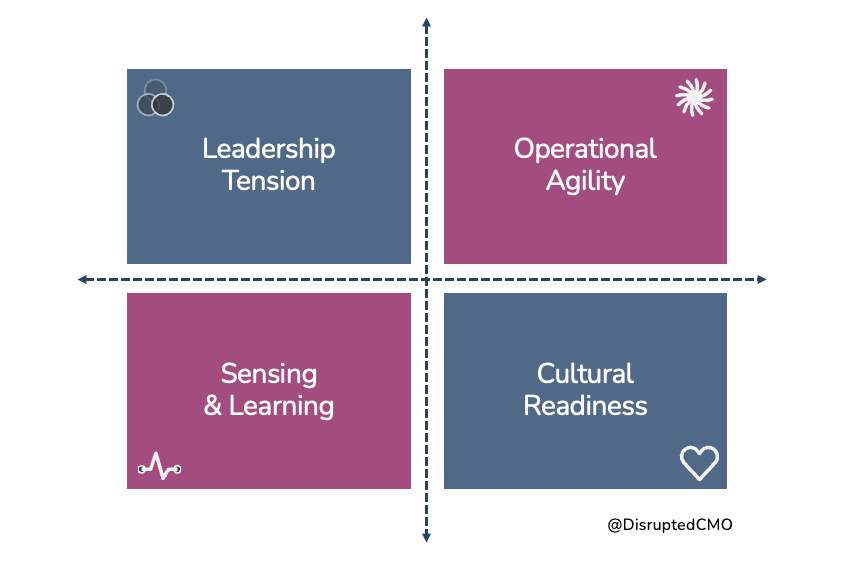
Dimension 1: Leadership Tension
Leadership Tension measures the degree to which marketing leaders effectively navigate the dynamic interplay between three distinct but entangled leadership functions that are essential to leading complex adaptive organizations: adaptive, enabling, and administrative.
Take the Disruption-Fluency Self-Assessment!
5-10 minutes, 20 questions, custom results and helpful content emailed and available for download.
This isn't about finding "balance" in some static sense; that's a false target. The balance point shifts constantly based on context. It's about productively managing the tensions between competing demands: the need for innovation and the need for operational stability; the desire for experimentation and the requirement for accountability; the push for speed and the pull of governance.
Adaptive leadership is the emergent, creative problem-solving that happens when teams confront novel challenges. It can't be mandated from the top down, it arises organically when conditions set by culture and leaders allow.
Administrative leadership is the traditional and often unglamorous management function: planning, coordinating, budgeting, measuring, etc. It doesn't gain much attention in trendy leadership books, but it is essential: you can't run a marketing (or any) organization without it.
Enabling leadership is the critical connector between the two. It creates the conditions, what researchers call "adaptive space," where innovation can flourish while managing the inevitable tensions with administrative needs. This is arguably the most undervalued and underdeveloped leadership function in most marketing organizations.
As mentioned, the goal isn't to eliminate tension. The goal is to harness productive tension to fuel creativity and adaptive thinking. That's a fundamentally different mindset than conflict avoidance or seeking of arbitrary balance.
Dimension 2: Operational Agility
Operational Agility captures the organization's ability to move from insight to action quickly, reallocate resources fluidly, and work iteratively rather than in overly rigid and long planning cycles.
This is where Agile Marketing principles translate into day-to-day execution. It's not about whether you run formal sprints or use Kanban boards, it's about whether you've internalized the underlying Agile values: delivering value early, often, and in short windows (aka "sprints"); empirical learning through experimentation and data over opinions and guesswork; responding flexibly and with speed to change over rigidly following a plan.
Operationally agile organizations can sense a shift in the market and respond meaningfully in days or weeks, not quarters. They can redirect budget and people toward emerging opportunities without heroic effort or organizational trauma. They run structured experiments with clear hypotheses and actually apply what they learn on a consistent basis as a core part of their DNA.
Agile Marketing provides the operating system for disruption-fluent marketing organizations. But operational agility without the other dimensions is brittle. Speed without sensing leads you to move fast in the wrong direction. Iteration without psychological safety produces superficial retrospectives where real problems go unspoken. Which tees up the final two dimensions.
Dimension 3: Sensing & Learning
Sensing & Learning is the intelligence system: the organization's capacity to detect emerging changes in its environment and systematically convert experience into organizational knowledge, hard-won insights into timely action.
This dimension encompasses environmental scanning across multiple time horizons, failure learning that generates genuine insight rather than defensive responses, and knowledge flow that moves insights from where they're generated to where they're needed. When deployed correctly it builds anticipatory capacity that positions you to shape and capitalize on disruption rather than merely respond to it.
An organization can be culturally ready for disruption, well-led, and operationally agile, but if it can't sense what's coming or learn from experience, it's flying blind.
Dimension 4: Cultural Readiness
Cultural Readiness is the foundation, and where most organizations should start their journey to disruption fluency. It's the human dimension that makes everything else possible: psychological safety, trust in leadership, capacity for change, and collaborative orientation.
Without psychological safety, adaptive leadership can't emerge: people won't take the personal risks required for innovation and change with confidence. Without trust in leadership during periods of uncertainty, enabling leadership loses credibility: people simply won't follow you into ambiguity. Without collaborative orientation, operational agility stalls in silos: cross-functional work becomes a series of negotiations rather than genuine partnership.
This dimension draws heavily from transformational leadership research. The ability to inspire commitment, build trust, and create meaning during change and uncertainty is what makes the other elements of the framework viable. You can install all the processes and structures you want, but culture determines whether your team is open to them and actually use them as intended.
"The market for something to believe in is infinite.”
- Hugh MacLeod, Gapingvoid
Cultural readiness is also where many organizations discover their binding constraint. They adopt agile practices, but the retrospectives never surface real issues because people don't feel safe being candid. They try to distribute decision-making authority, but people wait for permission because they don't trust that calculated risks will be rewarded. They invest in sensing systems, but the insights never reach leadership because the messenger fears being shot.
Note: Protecting creative headspace for your teams is one tangible manifestation of building cultural readiness.
The Reinforcing Loop
Here's what makes this a system, a framework, rather than simply a checklist: the dimensions exist in dynamic relationship with each other.
When they work together, they create a reinforcing cycle: Cultural safety enables adaptive leadership to emerge. Enabling leaders protect and scale adaptive work. Operational agility translates adaptive solutions into rapid execution. Sensing mechanisms capture learning from execution. Learning flows back into the system, informing the next adaptation. Success builds trust and confidence. Increased cultural safety enables more adaptive leadership.
When they don't work together, you get the opposite: cultural fear suppresses adaptive work; enabling leadership is absent so innovations die in bureaucracy; operational rigidity prevents response even when the need is clear; failure to learn means repeating mistakes; repeated failures erode trust; and the cycle spirals downward.
This systems view therefore has practical implications:
Sequence matters. You can't install operational agility in a culture that punishes failure. You can't expect adaptive leadership without enabling leaders to protect it. Start with the foundations - leadership development and cultural readiness - before expecting the operational and sensing capabilities to flourish.
Look for the binding constraint. In most organizations, one dimension is limiting the others. Often it's enabling leadership (the hardest to develop and least understood). Sometimes it's cultural safety. Occasionally it's operational rigidity or sensing gaps. Identifying the binding constraint focuses your efforts where they'll have the greatest leverage.
Isolated improvements are fragile. Strong sensing without matching operational agility will likely just create frustration; you see what's coming but can't respond. Adopting Agile Marketing practices in one part of the marketing team but not others risks failure across the organization as processes, work cadences, and even philosophies mismatch. Address the system, not just the symptoms.
Where to Start
If you're wondering where your organization stands across these four dimensions, the honest answer is: it probably varies. Most organizations have relative strengths and weaknesses. The question is which dimension is most limiting your ability to respond effectively to disruption.
A few diagnostic questions:
On Leadership Tension: When your organization faces a novel challenge, does creative problem-solving emerge naturally, or does everything route through formal approval chains?
On Operational Agility: How long does it take to go from a validated insight to something in market? Can you reallocate significant resources mid-year without organizational trauma?
On Sensing & Learning: Where do your market insights typically come from—internal analysis, or external surprise? When was the last time a failed initiative generated learning that meaningfully changed your approach?
On Cultural Readiness: In your last retrospective, did people share what actually went wrong, or what was safe to say? When leadership announces a major change, is the initial response energy, or anxiety?
Your Journey Is Unique
There's no single path to disruption fluency. Every organization has a different starting point, different strategic priorities, different cultural history, and different constraints. What matters is understanding where you stand, identifying your binding constraint, and recognizing that these four dimensions work as a system.
The organizations that thrive through times of disontinous change won't be the ones that focus on reacting to it or merely surviving it. They'll be the ones that have proactively built the organizational capability to anticipate it, absorb it, and capitalize on it, systematically and repeatedly.