
What Would an MBA-Level Class in Disruption Look Like?
When it comes to a business education, disruption shouldn't be treated as something that happens to someone else. What might an MBA class on disruption look like?
When I was working on my MBA at the University of Washington, seemingly about 50 tech innovation cycles ago in 2001-2002, we were living through and attempting to digest several overlapping disruptions. The implosion of the DotCom Bubble from 2000 was still fresh on everyone's minds; hangover from the institutional insanity of Y2K was still fresh; blogging was just becoming a thing, with true "social media" still to come (Facebook didn't launch until 2004); and of course, more seriously, 9/11 and the brewing Global War on Terror was top of everyone's minds.
Despite that, the coursework - as generally excellent as it was - only briefly touched on disruption, and that largely through the conceptual lenses of Christensen's Innovator's Dilemma and Schumpeter’s theory of creative destruction (so many S-curves...). Most of the coursework was more practical: operations management, financial accounting, strategic marketing, and so on. Even today, from a cursory review of MBA curriculums, the focus remains on the practical application of core business concepts, with "disruption" being sprinkled throughout or in select cases explored through related courses such as Change Leadership or Design Thinking.
But looking back, the entire approach to disruption was essentially archaeological: dig through cases of companies that failed, identify what went wrong, derive a useful lesson, move on. The implicit assumption was that disruption was an event, something that happens periodically, can be studied after the fact, and prepared for in the way you might prepare for a natural disaster.
I don't fundamentally believe that's true anymore, if it ever was.
As I wrote in my very first post here, disruption is the new norm for marketing and business leaders. It is the expected constant, and learning how to navigate it and thrive through it is perhaps the most critical skill a business leader can have.
So here's a thought experiment I've been playing with for years: if I were designing* an MBA-level course on disruption, not disruption as case study, but disruption as daily reality, what would I actually teach?
(*disclosure: I am not a professor, and this is simply a thought exercise, so full respect to those who actually have to build and teach courses.)
The Syllabus
I'd build this course around five units, each addressing a different dimension of what it takes to lead through ongoing disruption. And yes, these map directly to the Disruption-Fluent Marketing framework I've been working on, because the same principles that apply to marketing organizations apply to any complex organization navigating constant change.
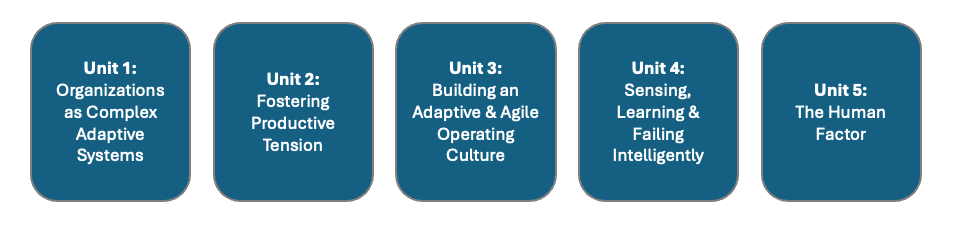
Unit 1: Organizations as Complex Adaptive Systems
The first thing I'd want students to tackle: unlearn the org chart. Business education, at least from my experience, tends to teach organizational structure as a relatively fixed thing: reporting relationships, spans of control, matrix vs. functional, etc. But anyone who's actually led a team through a crisis knows that the formal hierarchy is, at best, an approximation of how work actually gets done and decisions actually get made.
In other words, when it all "hits the fan", the formal org chart often goes out the window and the informal organizaitonal dynamics become paramount.
Because of this, complexity leadership theory offers a far more useful mental model. It views organizations as networks of interdependent agents whose interactions generate outcomes that can't be predicted from individual behaviors alone.
In practical terms: your marketing team (or engineering team, or any team) is a living system where ideas, influence, and information flow in patterns that have little to do with who reports to whom.
The course exercise here would be simple: map how a recent significant decision actually got made in a group or organization you've been a part of. Who influenced it? Where did the real insights originate? How did it move through the organization? Compare that to the formal decision-making process on paper. In my experience, the gap between those two maps is where the most important leadership lessons live.
Unit 2: Fostering Productive Tension
There is a real opportunity to reset student thinking in my view: we're often taught, through formal education or simply life experiences, that conflict is something to be resolved and alignment is the ultimate goal. But in a world of continuous disruption, the most valuable leadership skill isn't necessarily resolving tension, it's making productive use of it.
Think about the polarities every marketing leader navigates daily: building brand vs. feeding pipeline, developing long-term strategy vs delivering on quarterly results, creative risk-taking vs. brand safety, and so on. These aren't time-bound problems to be solved so much as ongoing tensions to be managed, and the leaders who try to permanently "resolve" them in one direction or another inevitably create whole new sets of problems.
I'd teach students Barry Johnson's polarity management framework alongside complexity leadership's concept of entanglement, something I explored in the DFM Framework in more detail: the idea that adaptive, enabling, and administrative leadership functions must coexist in productive tension in order for an organization to succeed, especially in times of change and disruption.
The course project here could be live scenario work where students have to explore some of the more common polarities business leaders face, and map out how to manage or even encourage productive tensions between them.
Unit 3: Building an Adaptive & Agile Operating Culture
This might be more familiar and comfortable to business schools and business students: tools, processes and methodologies. But with an important caveat: they all are in the service of fostering an adaptive and agile culture designed to maximize their effectiveness. Because tools and methodologies absent the right culture ends up just feeling like overwrought bureaucracy that clamps down on creativity, innovation, and speed.
The core concept I would cover here is what I call "minimum viable bureaucracy" aka the smallest amount of administrative structure necessary to enable rather than constrain your team's ability to respond. The insight students need to internalize is that operational agility isn't about eliminating process, it's about right-sizing process to the level of uncertainty you're facing. Novel challenges require different governance than routine, stable, and predictable work: faster cycles, more experimentation, and a vastly higher tolerance for ambiguity.
For coursework, I can think of a couple interesting exercises: I'd have students design two distinct operating systems for a sample organizations: one optimized for operational excellence, the other for exploration and creativity, and then mapping out the tensions and potential bridges between the two (as both must coexist in most companies). I can also envision an exercise where we analyze a complex organizational operating system, discuss what kinds of culture it might dictate, and then "MVB it" by stripping out down to a minimum.
Unit 4: Sensing, Learning, and Failing Intelligently
Market research and competitive analysis are core to pretty much every B-school curriculum, as well they should be. However I think an expanded lens, couched in disruption, could help shift student thinking - from research and analysis to building a true sensing and learning system, and one designed from the core to support a culture rapid iterative and intelligent failure.
This unit would cover the Sensing & Learning dimension of disruption fluency: how to build environmental scanning that goes beyond traditional competitive intelligence, how to design experiments that generate genuine insight and learning rather than just confirmation, how to create the organizational infrastructure to capture and share what you learn, and critically, how to foster the team culture that makes it receptive to those insights.
The hardest concept for many leaders to grasp is "productive failure" or the idea that well-designed experiments that don't produce the hoped-for result are still valuable if they generate insights that lead to learning. This is something I tell my teams constantly: failure is ok, even desirable, so long as it teaches us something and inspires us to ask "ok, what are we going to try differently next time?"
Many organizational cultures, despite paying lip service to innovation, make it risky to try something that doesn't work. Until that changes, all the sensing capabilities in the world won't matter because people will be too afraid to act on what they learn.
Unit 5: The Human Factor
I would wrap up the course somewhat ironically with the most important aspect of it: the people element. Psychological safety, trust, readiness for change, adaptibility, resilience in the face of uncertainty. These "soft skills" are the foundation everything else depends on.
Without psychological safety, adaptive leadership can't emerge because people won't take the risks necessary for creative problem-solving. Without trust in leadership, enabling leaders can't broker the compromises necessary to protect innovation from overbearing bureaucracy. Without a learning culture and an embrace of productive failures, retrospectives/AARs can become exercises in blame avoidance.
The Final
If I gave a final exam in this class, and given I despise them I would attempt not to, it would be a simulation of some kind. Here's an organization facing a challenging, ambiguous situation with incomplete data, competing stakeholder interests, real resource constraints, and a rapidly ticking clock. How would you lead through it?
I wouldn't do a traditional B-school case study. I'd be less interested in my students being able to diagnose where IBM went wrong or Blockbuster failed to adapt.
The rubric would look something like the Four Dimensions of Disruption Fluency: Can you read the situation accurately and decide which leadership functions the moment demands (enabling, adaptive, administrative, transformational)? How would you identify and foster productive tensions among them all, in a way that inspires rather than stifles creativity and risk-taking? How would you create a sensing and learning culture to meet the situation, from processes to team rituals?
Whatever the ultimate course structure, I firmly believe that preparing students to enter a workforce where constant disruption is the norm, equipping them with an understanding not just of the tools or best practices, but of the theory and human dynamics involved, is one of the most importants thing a modern business school can do. Now I just need to find a school willing to let me teach it!